See References below for a link to a PDF of my slides used on June 28, 2025.
Introducing LangTominoes
"LangTominoes" are a physical manifestation of pairs of numbers as defined in Langford's Problem.
[LINK]
LangTominoes embody the entanglement of pairs of numbers - always keeping their distance from each other. You move one number of the pair, the other moves too, because a LangTomino is solid / rigid.
LangTominoes have two "prongs", ⊓ ⊔, representing a pair of numbers — a pair of 1's, a pair of 2's, a pair of 3's, and so on.
For the number 'k', the two prongs are separated by k units.
Each prong is one unit wide because in Langford's Problem
each number of the pair takes up one location in the arrangement.
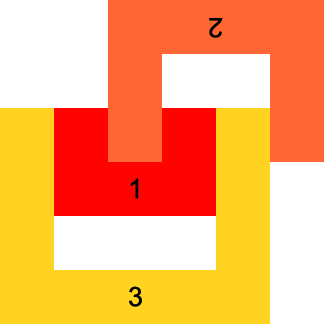
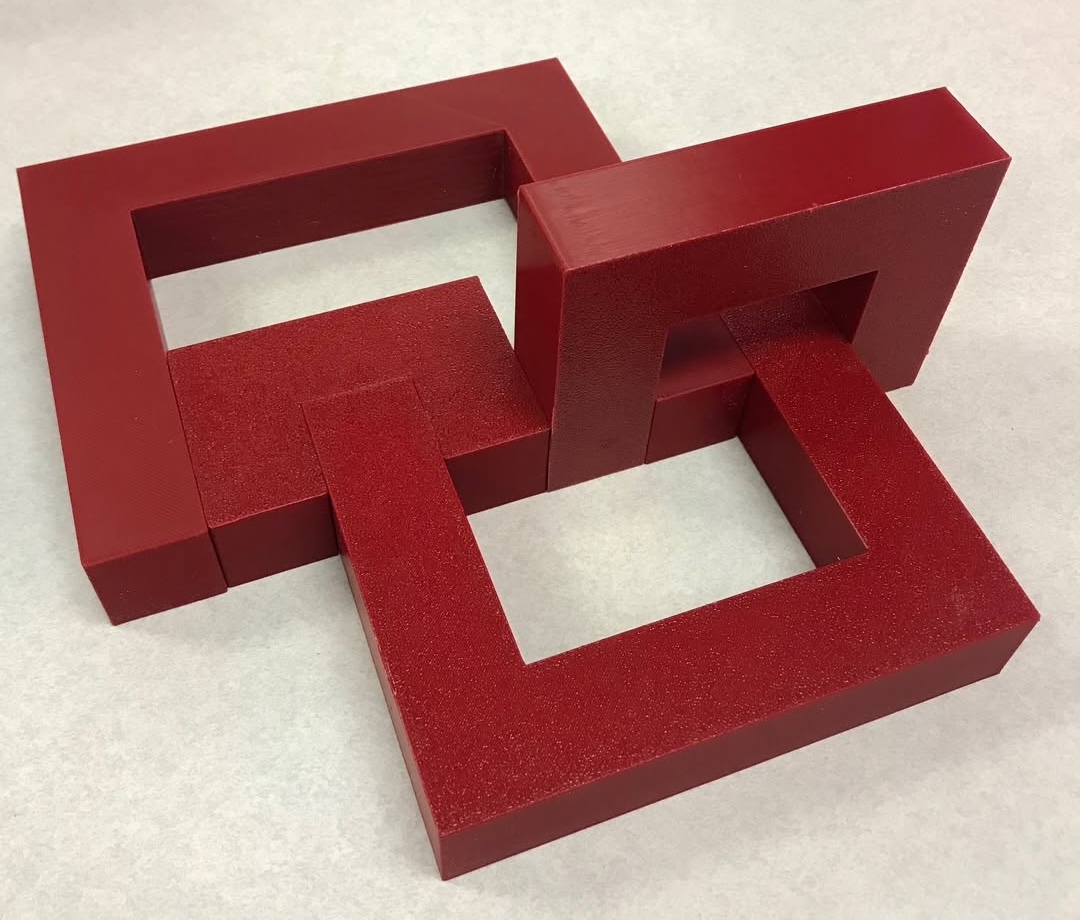
3D view of the 1 LangTomino
Can you see why this is a '1' LangTomino?
You could visualize each LangTomino being 'branded' with its number.
312132
The name 'LangTomino' is a mashup of Langford and Pentomino. This working term was coined by the author in April, 2025. The cap T is a reference to Robert's T - Party™ puzzle - see references.
BTW, there are an infinite number of LangTominoes... 1, 2, 3, 4, ... ∞
Anatomy and Measurements
Here are names for the parts of a LangTomino.
LangTomino Anatomy
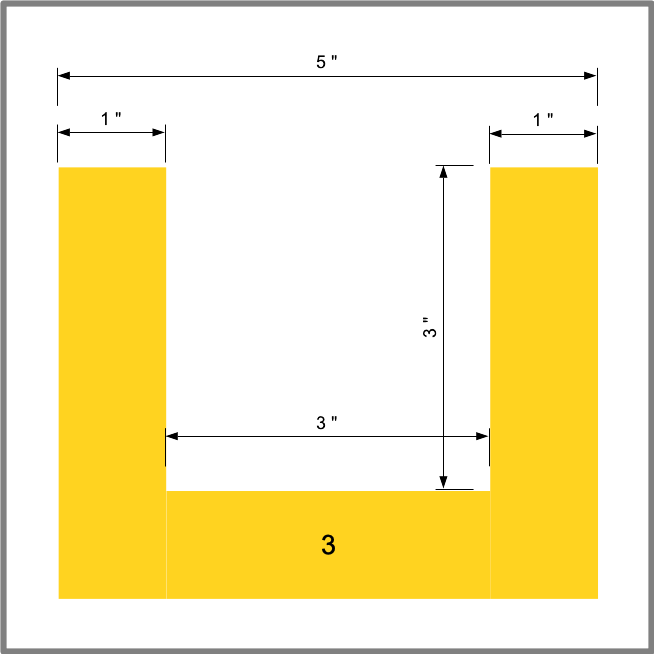
Here are the dimensions for the #3 LangTomino, in inches. A unit could instead be 18 millimeters, 1 centimeter, 1 meter, 1 mile, etc.
LangTomino dimensions for '3'. This one is in inches.
LangTominoes have thickness!
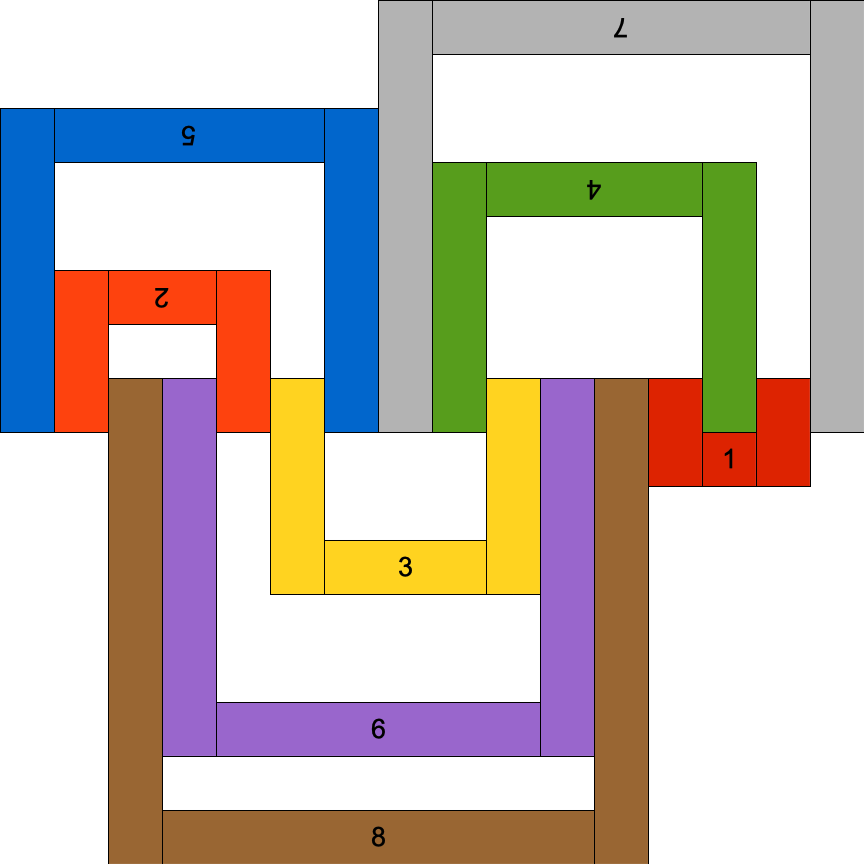
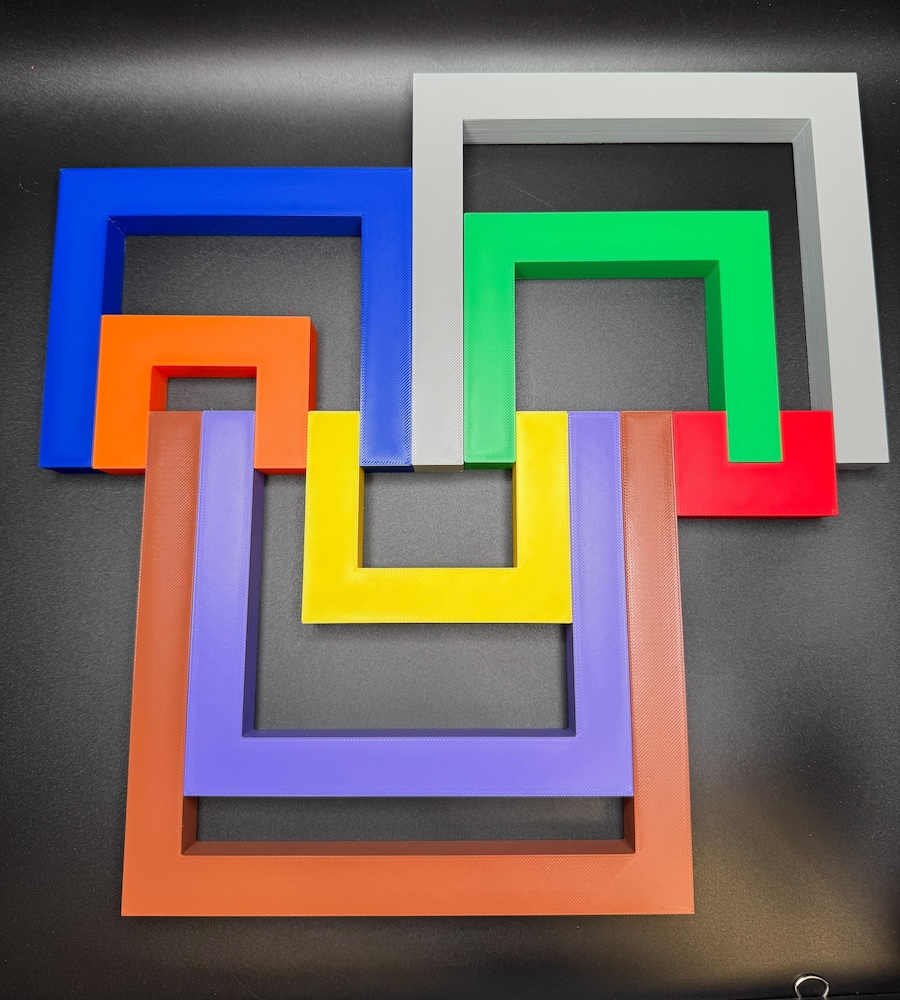
The diagram below is flat! Please imagine each colored piece also having unitary thickness.
8 LangTominoes representing the solution 5286235743681417
The colored area of these shapes is 124 square units. The area of piece 'k'is 3k+2, so the 8 pieces have total area equal to the Summation for k=1 to 8 of (3k+2).
The volume of these shapes would be 124 cubic units.
Official Colors — LoL
1 Red
2 Orange
3 Yellow or Light Yellow
4 Green or Grass Green
5 Blue
6 Purple or Dark Purple or Violet
7 Grey
8 Brown or beige


Black & White are common colors, but black gets 'lost' when placed on a black surface.
I have no colors for beyond 8 - other than using unique colors, or possibly repeating the above colors for 9-16!
Planar Solutions
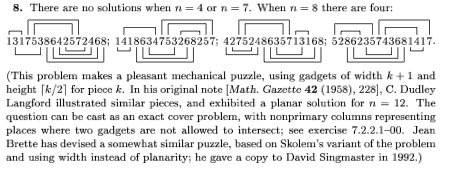
Here is an early blurb from Knuth,
Art of Computer Programming, on the 4 planar solutions for n=8.
Knuth's diagram shows the four planar solutions for 8 pairs
The vertical dimension is squeezed in Knuth's diagram, evidently to save space. (I admit to not giving this aspect much thought in my own diagrams in years past.)
The important thing is that pairs are connected with non-crossing lines.
Also note, a planar diagram must use the area above and below the linear arrangement.
Here are the 4 planar solutions for n=8, as given by Knuth, as text for your handy reference:
1317538642572468

1418634753268257

4275248635713168

5286235743681417*
*used in above pictured arrangement
3D-Printed LangTominoes
LangTominoes aren't flat tiles. As shown here, they can be made up of 1" wide 'bars' that are 1" thick.
First-ever 3D-Printed LangTominoes
The four above were printed at Talus Design 3D in southeast Portland in May 2025.
One material used in 3D Printing is 'PLA' (Polylactic Acid), and it is available in a wide range of colors.
Many available PLA colors
The eight below were printed by Items by CL in late June 2025.
Thickness is 18mm, the same as ItemsByCL's Hexominoes. See References below.
LangTominoes 1-8 made in Canada by ItemsByCL
These are available for purchase on line! See References below.
3D solutions
Let's say you are trying to discover a solution, with the pcs flat on the table.
What if you were allowed to stand a selected LangTomino up (on its two prongs) in a '3rd' dimension? Spatially, you'd use a vane orthogonal to the solution in progress. That way, you could avoid other LangTominoes in space, bridging up and over other prongs to connect two vacant positions.
3D could likewise go 'down and under' (the table) to connect two vacant positions.
OpenSCAD render of a 4 Vane arrangement for N=7
There are likely multiple ways of constructing these arrangements.
It seems like 3D might be able to 'cover' all solutions for Langford's Problem, non-planar included. What do you think?
I may write program to check this, and perhaps call for a proof or disproof. You are welcome to do this. I attribute contributors!
A Notation?
We need to define a notation (formula) for describing/communicating LangTomino arrangements. Such a notation would include which vane each number is in. Vanes are Y+, Y-, Z+, Z-. (The X-axis is where the arrangement gets longer.) The vane implicitly tells how a piece is oriented. Listing the order of the left prongs suffices. In the above arrangement, that ordering is: 2,3,7,6,5,1,4 !
For example, if we use a,b,u,d to represent the 4 vanes, the above could be written as [2u,3a,7b,6u,5a,1b,4d]
Now to agree on a grammar for the notation. Suggestions Welcome!
—jm
LangTomino Activity Booklet
This booklet explains what LangTominoes are and gives examples of what you can do wth them.
[LINK]
Practicing
Here is a 'Game Board" that will help you construct the four planar solutions for 8.
Download and print on legal size paper. Matches the scale of 18mm LangTominoes, if you print it properly..
LangTomino Board for Practicing.
See Downloads for link to the game board PDF.
Crowd Sourcing Exercise
We challenge the crowd (you) to try to construct all solutions for 7 and 8 using LangTominoes.
There are no Planar solutions for 7, and 8 has only four, so you will need to stand some LangTominoes up on their prongs, and perhaps even indicate a few coming 'up' from below.
(You're on your own here!)
Questions: Can all be constructed? If not, which ones can't? Why?
Here is a list of the 26 solutions for 7, and the 150 solutions for 8.
[LINK]
Possible games?
This section needs to be developed.
Solitaire - one person tries to construct solutions to the standard problem, or to come up with novel arrangements of any kind. Who knows?
Two Player (UNTESTED!) - Players divide up a set of LangTominoes (e.g. by drawing from pile?)
Players take turns by placing a LangTomino on the table, or possibly moving a previously played LangTomino before placing a new one. A Player can pass if they have no play that exhibits proper 'spacing'.
End Notes
The next step in this project will be to explore the combinatoric properties of LangTominoes. I have no timeframe for doing this.
Langford himself used a similar shape
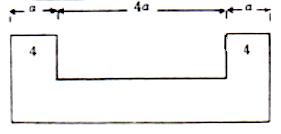
Langford published his original 1958 blurb in Mathematical Gazette, posing the question for which n's the arrangement is solvable, and calling for a theoretical treatment. Here was his method: "By experimenting with pieces of card cut as shown in the diagram, I have obtained (the following solutions for n pairs.."
He then listed solutions for 3, 4, 7, 8, 11, 12, and 15.
Diagram included in Langford's original 1958 "Problem"
Ref. The Mathematical Gazette, Vol. 42, No. 341 (Oct., 1958), p. 228
Definitions
prong
1. each of two or more projecting pointed parts at the end of a fork.
1a. a projecting part on various other devices:
a small rubber brush with large prongs.
2. each of the separate parts of an attack or operation: the three main prongs of the new government's program.
vane
2. the flat part on either side of the shaft of a feather (or arrow).
Rainbones
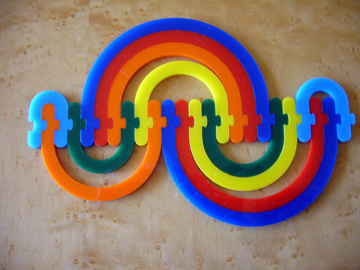
Donald Knuth and George Miller (no relation) along with Stan Isaacs made a plastic toy "Rainbones" using interlocking arcs. The bones must lie flat on the plane, so, only planar solutions can be represented.
a Rainbones solution for n=12
The Rainbones were cut out of plastic somehow.
Here's a page dedicated to Rainbones.
[LINK]
The zero-th LangTomino
The prongs for LangTomino #0 would be 0 units apart and 0 units long (tall). So, the 0th LangTomino would be a degenerate case, with no prongs, and a base of 2 units. LangTomino #0 would require two adjacent places for the pair of 0's. Read below about Nickerson's Variant.
Disclaimer: A pair of 0's like above is non-sensical, since Langford's Problem involves the numbers 1 thru n, not including zero. In Nickerson's Variant, the second number of pair 'k' appears k units after the first appearance of k. So, the 1's would be adjacent, zero spaces between them, but thy prongs would be 1 unit long. For now, I think we should all forget about Nickerson Lantominoes, but you are free to investigate.. on paper would be easy. --jm
Downloads
Please help yourself! (Creative Commons license applies.)
Zip of STL files for 3D printing. You'll need to specify/load colors when printing. One unit should be 18mm. (You can use any scale you want!)
[ZIP]
LangTomino Game Board - Download and print on legal size paper.
[PDF]
References
A link appears with each reference, to the source.
John Miller has spent a good amount of time developing this concept and preparing the information presented here.
So, he is placing this LangTomino page under a Creative Commons Attribution-NoDerivatives 4.0 International license
[CC BY-ND 4.0].
All John asks is notification and attribution of any use of the LangTomino form.
Please send notifications to TimeHavenMedia @ gmail.com — Thank You!